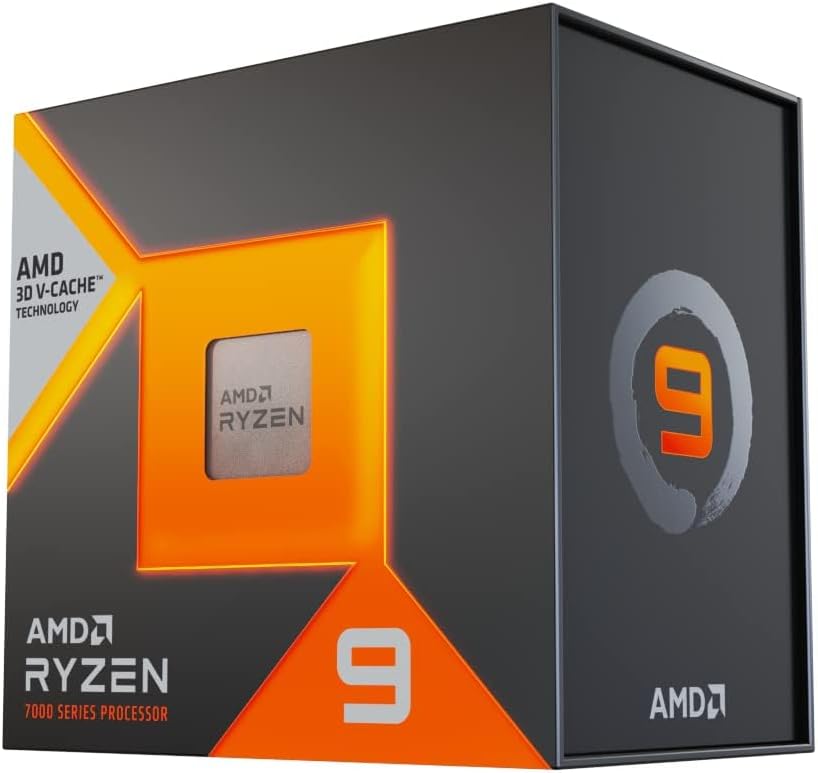
AMD Ryzen™ 9 7900X3D 12-Core, 24-Thread Desktop Processor
Want the best price and purchase timing?
Our AI advisor analyzes real-time pricing across all channels to find you the best deal.
AI Verdict
A 12-core, 24-thread AM5 processor with 140MB of cache and a 5.6 GHz max boost, designed for users balancing gaming and multi-threaded creative tasks.
This 12-core, 24-thread processor with 140MB of cache is a situational fit because its unique V-Cache implementation on only 6 cores means it doesn't consistently outperform the 7800X3D in gaming or the 7950X in all productivity tasks. It's for someone who specifically needs a blend of high-end gaming and multi-threaded capability on the AM5 platform, prioritizing power efficiency.
If your primary focus is gaming, look for a processor with 8 V-Cache enabled cores; if it's pure multi-threaded productivity, consider a CPU with more physical cores or a full 16-core V-Cache design.
Regret Score™
Low RiskLower is better — measures purchase-regret risk from real buyer complaints, review credibility, and product maturity
Issues discovered after purchase
Critically weak dimension
Amazon rating vs actual quality
Chance this product isn't for you
Pros
- Features 12 cores and 24 processing threads for demanding applications.
- Includes a large 140MB of cache (128MB L3 + 12MB L2) for enhanced performance.
- Achieves a 5.6 GHz Max Boost frequency for single-core speed.
- Operates with a 120W TDP, demonstrating power efficiency compared to other high-core count CPUs.
- Supports the AM5 platform, offering DDR5 memory and PCIe 5.0 connectivity.
- Integrates an RDNA 2-based Radeon iGPU for basic display output.
Cons
- Only 6 of the 12 cores have access to the 3D V-Cache, potentially limiting gaming performance compared to the 7800X3D.
- Multi-threaded performance can be surpassed by non-X3D Ryzen 9 processors or the 7950X3D in some productivity workloads.
- Requires a separate liquid cooler, which is not included in the box.
- Early users reported needing specific software adjustments or fresh Windows installs to optimize core scheduling for gaming.
- Initial pricing made it a less compelling value proposition compared to its siblings for specific use cases.
Dimension Scores
Achieves a 5.6 GHz Max Boost frequency, providing very high single-thread performance.
Offers 12 cores and 24 threads, delivering strong multi-threaded performance, though it can be surpassed by the 7950X3D or 7950X in some workloads.
Maintains a 120W TDP and 162W PPT, consuming less power than many comparable high-performance CPUs.
Utilizes the new AM5 socket, supporting DDR5 and PCIe 5.0, which ensures a modern upgrade path for several generations.
Best For
- Gaming at 1080p or 1440p with a high refresh rate monitor.
- Content creation tasks that benefit from 12 cores and 24 threads but also require strong gaming performance.
- Users building on the AM5 platform who want a balance of gaming and productivity without the top-tier cost of a 7950X3D.
- Systems where power efficiency and lower heat output are priorities for a high-performance CPU.
Not Recommended For
- Budget-focused gaming builds where the 7800X3D offers better gaming-specific value.
- Purely multi-threaded workstation environments where the 7950X or 7950X3D would provide more consistent core performance.
- Users unwilling to manage potential software optimizations for optimal V-Cache utilization.
Watch Out For
- The 3D V-Cache is only on one 6-core CCD, meaning not all 12 cores benefit from the increased cache, which can lead to inconsistent gaming performance if games don't utilize the correct cores.
- You'll need to buy a separate liquid cooler; the processor doesn't come with one.
- Some users experienced BSODs and black screen issues early on until chipset drivers were properly installed and BIOS settings tweaked.
- The initial launch price was often seen as too high, making it a less attractive option compared to other Ryzen 7000 series CPUs.
Full Specifications
| ASIN | B0BTRRNK7T |
| Brand | AMD |
| Series | AMD Ryzen 9 7900X3D |
| Language | English |
| CPU Model | Ryzen 9 |
| CPU Speed | 5.6 GHz |
| Processor | 5.6 GHz ryzen_9 |
| CPU Socket | Socket AM5 |
| Item Weight | 2.8 ounces |
| Manufacturer | AMD |
| Processor Brand | AMD |
| CPU Manufacturer | AMD |
| Item model number | AMD Ryzen 9 7900X3D |
| Product Dimensions | 1.57 x 1.57 x 0.1 inches |
| Computer Memory Type | DIMM |
| Number of Processors | 1 |
| Item Dimensions LxWxH | 1.57 x 1.57 x 0.1 inches |
What Buyers Say
Many users found the 7900X3D to be a bit of a 'middle child' in AMD's lineup, struggling to define its niche between the gaming-focused 7800X3D and the productivity powerhouse 7950X3D. The main sticking point for some was the V-Cache only being on one of its two 6-core chiplets, which meant not all cores benefited equally, leading to a need for careful system configuration or specific software fixes to ensure games ran on the optimal cores. Despite these nuances, its 12 cores and 24 threads still delivered a significant upgrade for many coming from older platforms, especially in mixed-use scenarios. The power efficiency was a recurring positive, allowing for cooler operation compared to some competitors.
“Man, I bought this thinking it was the best of both worlds, but sometimes my games feel weird, like it's not using the right cores or something. Should've just gotten the 7800X3D for gaming or the 7950X for my work stuff. It's fast, but it's complicated.”
Common Praise
- Provides a significant performance uplift from older Ryzen 3000 series CPUs.
- Runs cooler and consumes less power than many other high-end processors.
- Handles both gaming and multi-threaded applications capably.
- Offers a 5.6 GHz Max Boost clock for responsive single-core tasks.
- The AM5 platform ensures compatibility with current and future DDR5 and PCIe 5.0 components.
Common Complaints
- The 3D V-Cache is only active on 6 cores, making it less effective for gaming than the 7800X3D in some titles.
- Early issues with Windows scheduling sometimes prevented games from using the V-Cache enabled cores efficiently.
- Some users felt it didn't offer enough of a performance advantage over the cheaper 7800X3D for gaming or the 7900X for productivity at its initial price.
- Required careful BIOS tweaking and chipset driver installation to avoid stability issues like BSODs.
- The lack of an included cooler means an additional purchase is necessary.
Ownership Tips
- You'll likely spend some time in your BIOS and Windows settings to ensure games are properly utilizing the V-Cache enabled cores.
- Expect to invest in a robust liquid cooling solution, as this processor doesn't come with one and runs best with ample cooling.
- Performance can vary significantly between games depending on how well they utilize the V-Cache and how your system is configured.
- The integrated graphics are useful for troubleshooting but aren't meant for serious gaming.
- The AM5 platform means you're set for future CPU upgrades, which is a plus for long-term builds.
Frequently Asked Questions
Does the AMD Ryzen 9 7900X3D come with a cooler?
No, the AMD Ryzen 9 7900X3D does not include a cooler. AMD recommends using a liquid cooler for optimal performance.
Is this CPU good for gaming?
Yes, it offers strong gaming performance, especially for CPU-intensive titles, due to its 3D V-Cache and 5.6 GHz Max Boost. However, some users report the 7800X3D can be better for gaming due to its V-Cache configuration.
What motherboard socket does this processor use?
This processor uses the Socket AM5, which supports DDR5 memory and PCIe 5.0 on compatible 600 Series motherboards.
How many cores and threads does the 7900X3D have?
The AMD Ryzen 9 7900X3D features 12 cores and 24 processing threads.
Does this CPU have integrated graphics?
Yes, it includes an RDNA 2-based Radeon iGPU with 2 CUs, providing basic graphics capabilities.
Is the 7900X3D power efficient?
Yes, with a 120W TDP and 162W PPT, it is considered more power efficient than many other high-performance CPUs, including some Intel offerings.
Buying Guide
When you're looking at a CPU like this, you need to think about what you actually do most often. This isn't just about raw core count; it's about how those cores are configured and how software uses them. If you're a gamer who also does some video editing or streaming, this chip tries to hit that sweet spot, but it has its quirks. You'll need to be comfortable with a bit of tweaking to get the most out of it.
Cores and Threads (12 Cores, 24 Threads)
Think of cores as individual workers and threads as tasks each worker can handle simultaneously. 12 cores and 24 threads means this CPU can juggle a lot of demanding applications at once, like running a game, streaming, and having Discord open without slowing down.
3D V-Cache (140MB total cache)
This is like a super-fast, extra-large scratchpad for the CPU. For games, having a lot of V-Cache can dramatically reduce latency and boost frame rates, especially in titles that are sensitive to CPU performance. However, on this specific chip, only half the cores get this benefit, which is important to remember.
Max Boost Clock (5.6 GHz)
This is the maximum speed a single core can reach under ideal conditions. Higher boost clocks mean snappier performance in tasks that don't use all cores, like many games or everyday applications. It's like how fast a single car can go on the highway.
Socket AM5
This refers to the physical connection on your motherboard where the CPU sits. AM5 is AMD's newest platform, meaning it supports the latest technologies like DDR5 memory and PCIe 5.0, and it's expected to be supported for several generations, giving you future upgrade options.
Alternatives
If you're purely a gamer, look for a CPU with 8 V-Cache enabled cores for more consistent gaming performance; if your work is heavily multi-threaded, consider a processor with 16 cores and a full V-Cache implementation or higher clock speeds across all cores.
You Might Also Like

INTEL INTEL XEON Gold 6246R Processor (35.75M Cache, 3.40 GHZ)
$600+This is a 1-core, 3.40 GHz Xeon Gold processor designed for highly specialized server tasks, not general computing.

INTEL INTEL XEON Gold 6250 Processor (35.75M Cache, 3.90 GHZ)
$600+This is a 1-core, 3.9 GHz Intel Xeon Gold processor with 35.75MB cache, making it an unusual fit for demanding data center workloads.

AMD Ryzen 5 3600 6-Core, 12-Thread Unlocked Desktop Processor with Wraith Stealth Cooler
This 6-core, 12-thread AM4 processor with a 4.2 GHz max boost is for budget PC builders needing 100+ FPS in 1080p games and basic multitasking.

AMD Ryzen 7 3700X 8-Core, 16-Thread Unlocked Desktop Processor with Wraith Prism LED Cooler
An 8-core, 16-thread AM4 processor with a 4.4 GHz max boost, bundled with an RGB cooler, suitable for multi-threaded tasks.