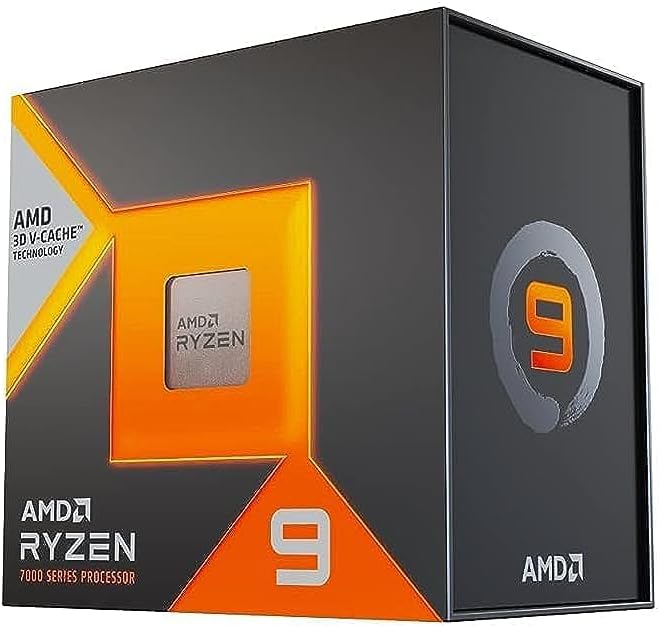
AMD Ryzen™ 9 7950X3D 16-Core, 32-Thread Desktop Processor
Want the best price and purchase timing?
Our AI advisor analyzes real-time pricing across all channels to find you the best deal.
AI Verdict
This 16-core, 32-thread AM5 processor with 144MB of cache delivers top-tier gaming and strong productivity, but requires software tuning for optimal performance.
This 16-core, 32-thread processor with 144MB of cache is a strong contender for users who demand both top-tier gaming and substantial multi-threaded performance. However, its dual-CCD architecture means you'll need to actively manage which applications run on which cores to unlock its full potential, making it less of a 'set it and forget it' solution.
If you're solely focused on gaming, consider the 7800X3D for a simpler, often equally performant gaming experience; for pure multi-threaded work, the 7950X might offer slightly higher sustained clocks.
Regret Score™
Low RiskLower is better — measures purchase-regret risk from real buyer complaints, review credibility, and product maturity
Issues discovered after purchase
Critically weak dimension
Amazon rating vs actual quality
Chance this product isn't for you
Pros
- Achieves 5.7 GHz Max Boost for demanding single-threaded tasks.
- Features 144MB of cache, providing significant frame rate increases in many games.
- Consumes less power during gaming compared to non-X3D counterparts.
- Supports the state-of-the-art Socket AM5 platform, including DDR5 memory and PCIe 5.0 [product data].
- Runs cooler than the 7950X during gaming workloads, often staying below 65°C with liquid cooling.
Cons
- Requires software like Process Lasso for optimal task affinity management between its two CCDs.
- Exhibits slightly lower multi-threaded performance in some applications (e.g., Cinebench R23, Blender) compared to the 7950X.
- Does not include a cooler, and liquid cooling is recommended for thermal management [product data].
- Draws 30-40W more power at idle than Intel's i9-13900K.
- Early BIOS versions on AM5 motherboards sometimes caused extended boot times and EXPO instability.
Dimension Scores
The processor achieves a 5.7 GHz Max Boost clock, delivering top-tier single-threaded performance [product data].
With 16 cores and 32 threads, it offers substantial multi-threaded capabilities, though it can be slightly behind the 7950X in some heavy workloads [product data, cite: 7, 9, 10].
It demonstrates lower power consumption during gaming compared to its non-X3D counterpart, making it easier to cool.
Built on the new Socket AM5 platform with support for DDR5 and PCIe 5.0, it offers excellent future-proofing for upgrades [product data].
Best For
- High-refresh rate 1440p and 4K gaming with an RTX 4080 or 4090.
- Simultaneous streaming, gaming, and content creation on a single PC.
- Users who need 16 cores for productivity but prioritize gaming performance above all else.
- Enthusiasts building a new AM5 system who want a hybrid gaming and workstation CPU.
Not Recommended For
- Pure productivity workstations where every percentage of multi-core performance is critical and gaming is not a factor.
- Budget-conscious gamers who only play games and don't need 16 cores.
- Users unwilling to engage with software optimization tools for CPU core management.
Watch Out For
- Ryzen Master software has been reported to cause system instability and boot issues, requiring a CMOS clear.
- One of the two CCDs (the 3D V-Cache enabled one) can hit its 89°C thermal limit very quickly under load, even with a 360mm AIO cooler.
- Achieving optimal performance in mixed workloads often necessitates manual core affinity management via tools like Process Lasso.
- The 3D V-Cache CCD operates at lower clock speeds than the non-cached CCD, which can lead to performance inconsistencies if games or applications don't correctly utilize the cached cores.
- Idle power consumption can be 30-40W higher than competing Intel Core i9-13900K processors.
Full Specifications
| ASIN | B0BTRH9MNS |
| Brand | AMD |
| Series | AMD Ryzen 9 7950X3D |
| Language | English |
| CPU Model | Ryzen 9 7950X |
| CPU Speed | 5.7 GHz |
| Processor | 5.7 GHz ryzen_9_7950x |
| CPU Socket | Socket AM5 |
| Item Weight | 2.79 ounces |
| Manufacturer | AMD |
| Processor Brand | AMD |
| CPU Manufacturer | AMD |
| Item model number | AMD Ryzen 9 7950X3D |
| Product Dimensions | 5.12 x 3.58 x 5.08 inches |
| Computer Memory Type | DIMM |
| Number of Processors | 1 |
| Item Dimensions LxWxH | 5.12 x 3.58 x 5.08 inches |
What Buyers Say
This chip is a bit of a balancing act; you get phenomenal gaming performance thanks to that 144MB of 3D V-Cache, often seeing significant frame rate bumps over the non-X3D version. However, getting the most out of its 16 cores for both gaming and productivity means you'll likely be fiddling with software like Process Lasso to direct tasks to the right core complex. While it sips power during gaming, some users have noted higher idle power draw compared to Intel chips, and early AM5 boot times were a drag until BIOS updates rolled out.
“Dude, this thing absolutely shreds in games, like Warzone went from 180 to 230 FPS for me! But seriously, you gotta mess with Process Lasso or something to make sure your games use the right cores, otherwise it's just leaving performance on the table. And yeah, it needs a beefy liquid cooler.”
Common Praise
- Provides a noticeable uplift in gaming frame rates, especially in titles that benefit from large caches.
- Maintains lower operating temperatures during gaming, often staying below 65°C with a 360mm AIO.
- Draws less power than the 7950X and Intel's i9-13900K during gaming sessions.
- Offers a strong combination of gaming prowess and 16 cores for demanding creative tasks.
Common Complaints
- Requires manual intervention with software tools to ensure applications use the optimal CPU cores.
- Can be outperformed by the 7950X in certain heavy multi-threaded productivity benchmarks like Cinebench R23.
- The 3D V-Cache CCD can reach its 89°C thermal limit very quickly, even with robust cooling.
- Idle power consumption is higher than some competing processors.
- Initial AM5 platform boot times were lengthy, though BIOS updates have improved this.
Ownership Tips
- You'll want to update your motherboard's BIOS immediately to address early boot time and EXPO stability issues.
- Learning to use Process Lasso or similar tools to set CPU affinity for games and applications is almost a requirement for consistent optimal performance.
- A high-quality 360mm AIO liquid cooler is not optional; this chip runs hot on the cached CCD [product data, cite: 13].
- Be cautious with AMD Ryzen Master software; some users reported it causing system instability.
- Expect to see the 3D V-Cache CCD hit its 89°C thermal limit quickly, even if overall package temps are lower.
Frequently Asked Questions
Does the AMD Ryzen 9 7950X3D come with a CPU cooler?
No, a CPU cooler is not included with the processor. A liquid cooler is recommended for optimal thermal performance [product data].
Is the 7950X3D better than the standard 7950X for gaming?
Yes, the 7950X3D generally offers higher gaming performance due to its 144MB of 3D V-Cache, which significantly benefits many games.
How does its productivity performance compare to the 7950X?
In heavy multi-threaded productivity tasks, the 7950X3D can be slightly slower than the 7950X because its 3D V-Cache enabled CCD often runs at lower clock speeds.
What motherboard socket does this processor use?
It uses the Socket AM5 platform, which supports DDR5 memory and PCIe 5.0 [product data].
Do I need special software to get the best performance?
Yes, AMD drivers and potentially third-party tools like Process Lasso are often needed to ensure games and applications utilize the correct CCD for optimal performance.
Were there issues with boot times on the AM5 platform?
Early AM5 motherboards sometimes had longer boot times, but these issues have largely been resolved with subsequent BIOS updates.
Buying Guide
When you're looking at a CPU like this, you're essentially getting two processors in one: one part with extra-fast cache for games, and another with raw core count for heavy work. The trick is making sure your computer knows which part to use for what. This chip is built on AMD's newest AM5 platform, so you'll need a compatible motherboard and DDR5 RAM, which means a full system upgrade if you're coming from an older setup.
16 Cores and 32 processing threads
144MB of cache
5.7 GHz Max Boost
Socket AM5 platform, DDR5 support, PCIe 5.0
Alternatives
If you're primarily a gamer and don't need the 16 cores for heavy productivity, look for CPUs with a high amount of 3D V-Cache but fewer cores. If your focus is purely on multi-threaded workloads like rendering or video editing, consider CPUs with high core counts and higher sustained all-core clock speeds.
You Might Also Like

INTEL INTEL XEON Gold 6246R Processor (35.75M Cache, 3.40 GHZ)
$600+This is a 1-core, 3.40 GHz Xeon Gold processor designed for highly specialized server tasks, not general computing.

INTEL INTEL XEON Gold 6250 Processor (35.75M Cache, 3.90 GHZ)
$600+This is a 1-core, 3.9 GHz Intel Xeon Gold processor with 35.75MB cache, making it an unusual fit for demanding data center workloads.

AMD Ryzen 5 3600 6-Core, 12-Thread Unlocked Desktop Processor with Wraith Stealth Cooler
This 6-core, 12-thread AM4 processor with a 4.2 GHz max boost is for budget PC builders needing 100+ FPS in 1080p games and basic multitasking.

AMD Ryzen 7 3700X 8-Core, 16-Thread Unlocked Desktop Processor with Wraith Prism LED Cooler
An 8-core, 16-thread AM4 processor with a 4.4 GHz max boost, bundled with an RGB cooler, suitable for multi-threaded tasks.