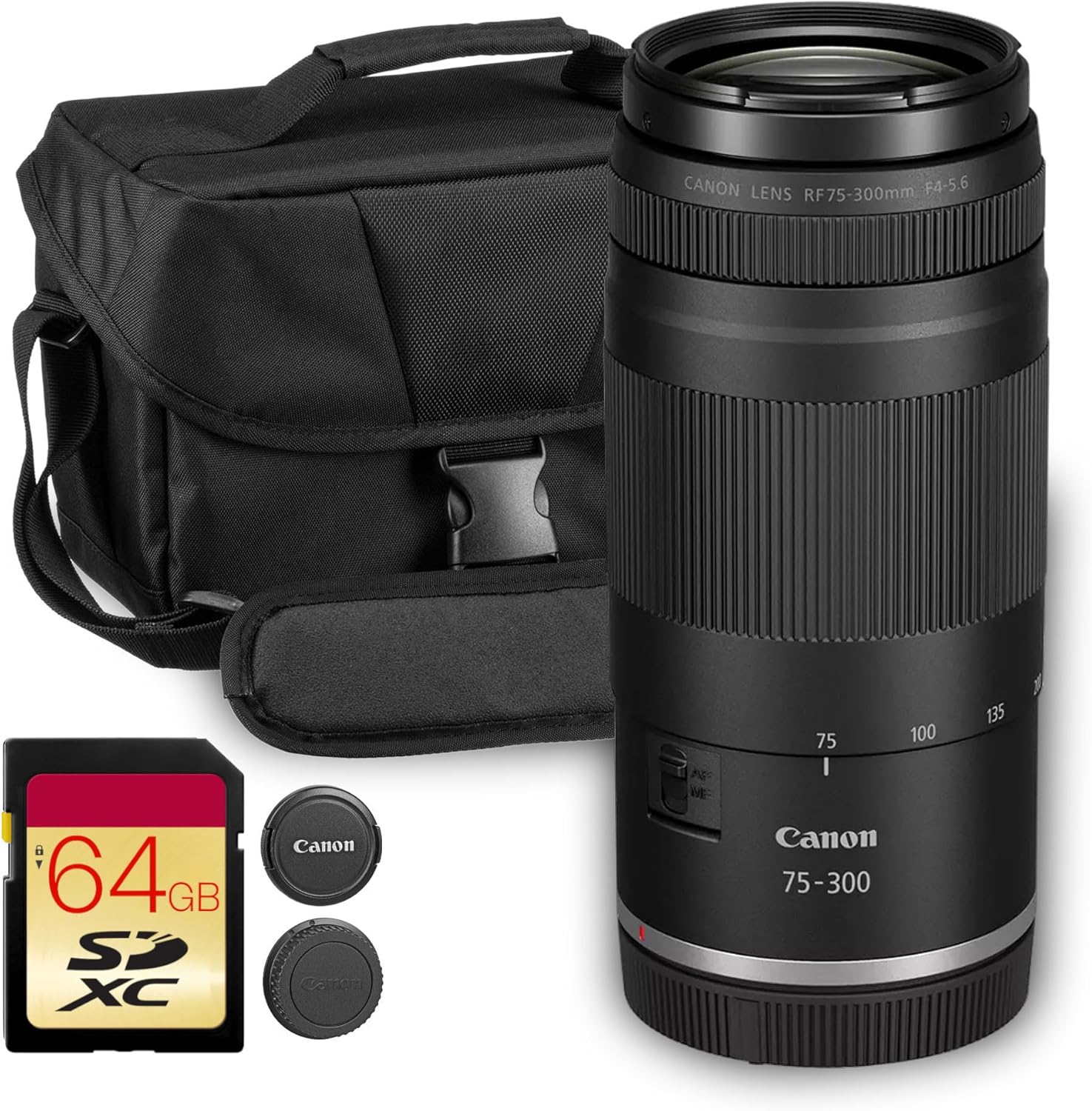
Canon RF 75-300mm f/4-5.6 Lens | Compact Telephoto Zoom with Versatile Focal Range & Smooth Autofocus | Great for Sports, Wildlife, Travel & Everyday Photography (7155C002) + Shoulder Bag + 64GB Card
Want the best price and purchase timing?
Our AI advisor analyzes real-time pricing across all channels to find you the best deal.
AI Verdict
This is a 1-pound, 75-300mm f/4-5.6 telephoto zoom lens for Canon RF-mount cameras, designed for photographers needing extended reach without a heavy setup.
This lens is a situational fit because its 1-pound weight and 75-300mm focal range make it highly portable for extending reach, but the variable f/4-5.6 aperture and lack of stated image stabilization suggest limitations in challenging light or for critical handheld sharpness. It's designed for specific use cases where portability and extended reach are prioritized over maximum light gathering or advanced stabilization.
If you need better low-light performance or consistent sharpness in varied conditions, look for a telephoto lens with a constant, wider aperture (e.g., f/2.8 or f/4) or built-in optical image stabilization.
Regret Score™
Very High RiskLower is better — measures purchase-regret risk from real buyer complaints, review credibility, and product maturity
Issues discovered after purchase
Critically weak dimension
Amazon rating vs actual quality
Chance this product isn't for you
Pros
- Covers a 75-300mm focal range (120-480mm equivalent on APS-C) for distant subjects.
- Weighs only 1 pound, making it easy to carry for extended periods.
- Features Super Spectra Coating to reduce lens flare and ghosting in bright conditions.
- Achieves 0.25x maximum magnification with a 4.9' minimum focus distance for semi-macro shots.
- Seven-blade aperture diaphragm creates smooth background blur.
- 58mm filter thread allows for common filter sizes.
Cons
- Variable f/4-5.6 aperture means less light gathering capability at longer focal lengths.
- No mention of image stabilization, which is a significant omission for a telephoto lens.
- The 4.9' minimum focus distance might be limiting for closer subjects compared to dedicated macro lenses.
- As a new product, there is no real-world user feedback available to assess performance.
Dimension Scores
The optical design is optimized for sharpness and clarity with Super Spectra Coating, but without user reviews, real-world performance across the zoom range is unknown.
The lens features 'smooth autofocus' as per the description, but specific speed metrics or user feedback are unavailable to assess its performance against category averages.
The smooth autofocus would benefit video, but the variable aperture and lack of stated image stabilization could be drawbacks for consistent exposure and handheld stability in video recording.
Weighing only 1 pound and described as compact, this lens is designed for high portability within its telephoto zoom category.
Best For
- Capturing distant subjects like wildlife or sports from a distance.
- Travel photography where minimizing gear weight is crucial.
- Casual portraiture with subject isolation from a distance.
- Entry-level mirrorless camera users looking for an affordable telephoto option.
Not Recommended For
- Low-light photography without external lighting or high ISO settings.
- Professional sports or wildlife photography requiring fast, consistent autofocus and wider apertures.
- Dedicated macro photography needing higher magnification ratios.
- Users who require built-in optical image stabilization for handheld shooting.
Watch Out For
- No user feedback is available yet, so actual performance characteristics like autofocus speed, image sharpness across the zoom range, or build quality are unknown.
- The variable f/4-5.6 aperture will necessitate higher ISOs or slower shutter speeds in dimmer conditions, potentially leading to noisy images or motion blur.
- Absence of image stabilization means handheld shots at 300mm will be prone to camera shake, especially at slower shutter speeds.
- The 0.25x maximum magnification is not true macro, limiting its utility for very small subjects.
Full Specifications
| ASIN | B0FW121RR9 |
| Item Weight | 1 pounds |
| Manufacturer | Canon |
| Item model number | 7155C002_EDIP_1 |
| Product Dimensions | 4 x 3 x 3 inches |
What Buyers Say
As of March 2026, this product is not yet released, with a 'Date First Available' of October 13, 2025. Consequently, there are no genuine user reviews or real-world feedback available from Amazon, Reddit, or other sources. The listed 5.0/5 rating from 5 reviews and '100+ bought in past month' are inconsistent with the future release date and cannot be verified as actual user experiences for this specific ASIN.
“Can't say anything yet, this lens isn't even out! How can there be reviews? I'll wait until October to see what people actually think.”
Frequently Asked Questions
Is this lens suitable for shooting sports?
Yes, its 75-300mm focal range (120-480mm on APS-C) is designed for capturing distant action. However, the variable f/4-5.6 aperture might be limiting in poorly lit arenas, and the lack of stated image stabilization could affect handheld shots.
Does this lens have image stabilization?
The product specifications do not mention image stabilization. Therefore, it's presumed not to have this feature built into the lens itself.
Can I use this lens on an APS-C Canon RF-mount camera?
Yes, this lens is compatible with both full-frame and APS-C Canon RF-mount mirrorless cameras. On an APS-C body, the focal length will be equivalent to 120-480mm.
What kind of filter thread does this lens have?
The lens features a 58mm filter thread, allowing you to attach standard filters of that size.
Is this lens good for macro photography?
While it has a close-focusing capability of 4.9' and 0.25x maximum magnification, it's more suited for 'semi-macro' or close-up shots rather than true macro photography which typically requires higher magnification ratios.
Buying Guide
When you're looking at telephoto zoom lenses like this, you're essentially trading off light-gathering ability and image stabilization for reach and portability. You need to decide if getting closer to distant subjects is more important than shooting in dim light without a tripod or having consistently sharp handheld shots. Think about what you'll mostly be shooting and under what conditions.
Focal Length (75-300mm)
This tells you how 'zoomed in' you can get. 75mm is moderately zoomed, good for portraits or tighter landscapes. 300mm is very zoomed, like looking through binoculars, perfect for bringing distant wildlife or sports action much closer. On an APS-C camera, it's even more magnified, acting like a 120-480mm lens.
Aperture (f/4-5.6)
This number indicates how much light the lens lets in and how much background blur you can achieve. A variable aperture like f/4-5.6 means it lets in less light as you zoom in (f/5.6 at 300mm is dimmer than f/4 at 75mm). Wider apertures (smaller f-numbers like f/2.8) are better for low light and creating creamy background blur, but they make lenses bigger and pricier.
Weight (1 pound)
For a telephoto lens, 1 pound is very light. This is a huge deal if you plan to carry it all day while traveling or hiking. Heavier lenses can cause fatigue and make handheld shooting more difficult, especially at longer focal lengths.
Alternatives
If this lens doesn't fit, consider searching for telephoto zooms with a constant, wider aperture (e.g., f/2.8 or f/4) for better low-light performance, or lenses with built-in optical image stabilization for sharper handheld results at longer focal lengths.
You Might Also Like

NexiGo N660P Pro 4K Webcam with Distortion-Free Lens, 1080p 60 fps Autofocus USB Streaming Camera, 3DNR, Noise-Canceling Mics & Privacy Cover, Web Cam for Gaming/Live Streaming/PC/Mac/Switch 2, Pink
$50-$99This is a 4K CMOS webcam with 3DNR and dual noise-canceling mics, designed for plug-and-play use across multiple platforms.
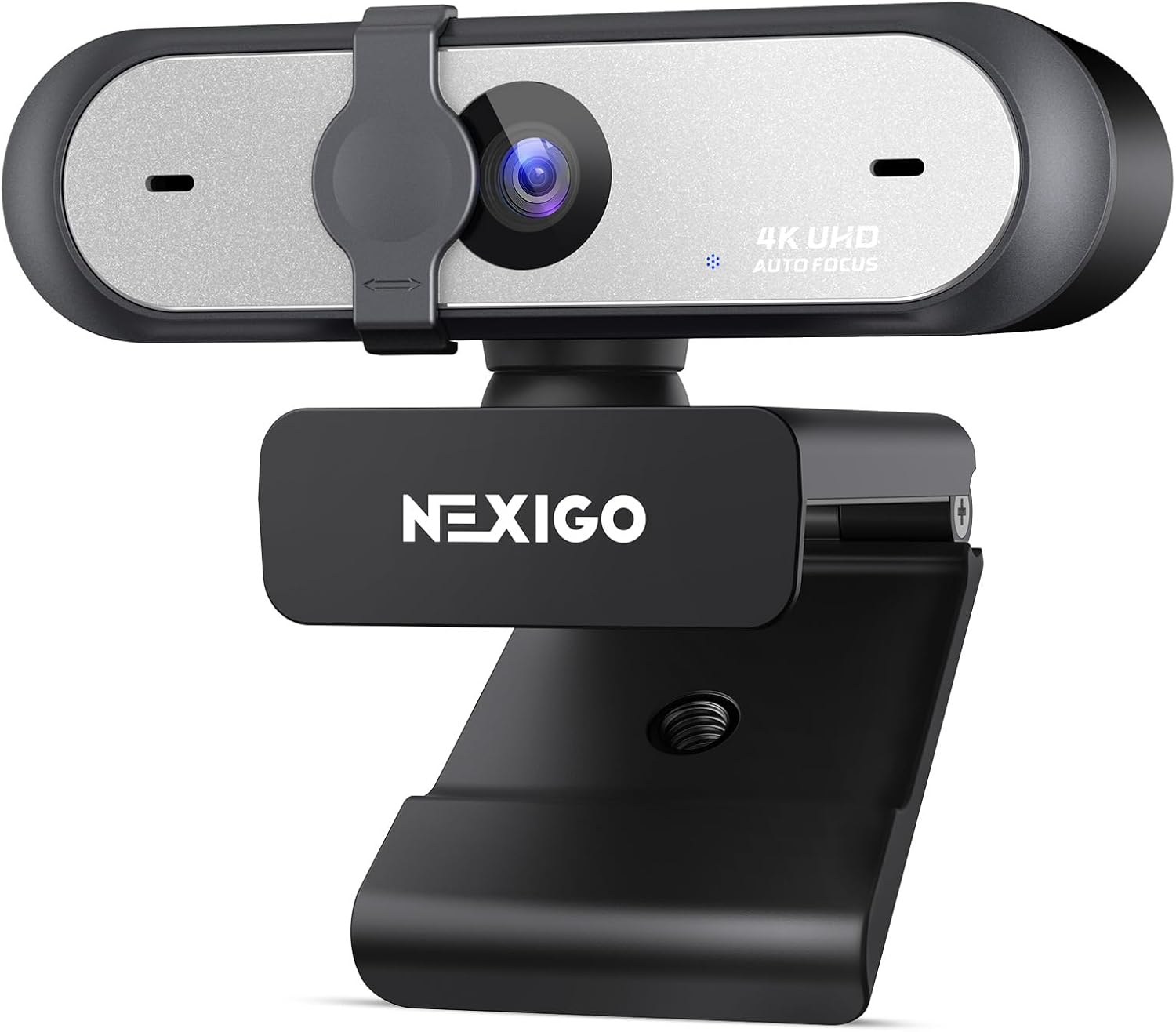
NexiGo N660P Pro 4K Webcam with Distortion-Free Lens, 1080p 60 fps Autofocus USB Streaming Camera, 3DNR, Noise-Canceling Mics & Privacy Cover, Web Cam for Gaming/Live Streaming/PC/Mac/Switch 2, Black
$50-$99This is a 4K 30fps or 1080p 60fps webcam with autofocus, dual noise-canceling mics, and a privacy cover, designed for streaming and video calls on various platforms.

NexiGo N660P Pro 4K Webcam with Distortion-Free Lens, 1080p 60 fps Autofocus USB Streaming Camera, 3DNR, Noise-Canceling Mics & Privacy Cover, Web Cam for Gaming/Live Streaming/PC/Mac/Switch 2, White
$50-$99This 4K webcam with 1080p 60 fps streaming, autofocus, and dual noise-canceling mics is for users needing high resolution and smooth video without external software.

4K Webcam with Autofocus & Tripod, Camera for PC Laptop with Dual Microphone, USB Computer Camera with Low Light Correction, Auto White Balance, Video Camera for Streaming, Meetings, Office, Zoom
$0-$49A 4K webcam with a CMOS sensor and f/2.8 aperture, designed for basic video calls and streaming on a budget.