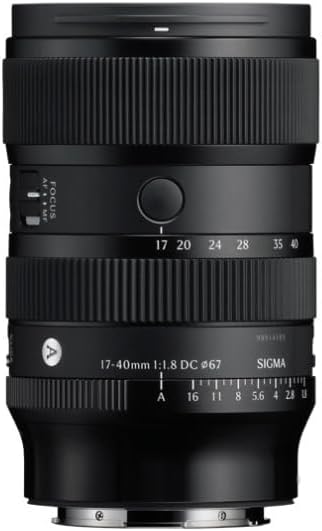
Sigma 17-40mm F1.8 DC | Art for Sony E
Want the best price and purchase timing?
Our AI advisor analyzes real-time pricing across all channels to find you the best deal.
AI Verdict
This 1.16-pound APS-C standard zoom with a constant F1.8 aperture is for videographers and low-light shooters who need internal zoom and an aperture ring.
This lens is a strong contender for APS-C users prioritizing a constant F1.8 aperture and internal zoom for video, especially on gimbals. However, its 1.16-pound weight, optical compromises at wider apertures, and limited telephoto reach make it a specialized tool rather than an all-around solution.
If you need more telephoto reach or prefer a lighter setup for everyday photography, look for lenses with a wider zoom range and potentially a smaller maximum aperture.
Regret Score™
High RiskLower is better — measures purchase-regret risk from real buyer complaints, review credibility, and product maturity
Issues discovered after purchase
Critically weak dimension
Amazon rating vs actual quality
Chance this product isn't for you
Pros
- Maintains a constant F1.8 aperture across the 17-40mm zoom range, allowing for consistent low-light performance and shallow depth of field.
- Features an internal zoom mechanism, which is beneficial for gimbal use and maintaining balance.
- Equipped with an aperture ring for tactile control, which is particularly useful for video work.
- Offers HLA-driven high-speed autofocus, providing quick and reliable focus for everyday shooting.
- Designed with a dust- and splash-resistant structure and a water- and oil-repellent coating for use in varied conditions.
- Exhibits minimal focus breathing, making it suitable for video recording without distracting changes in focal length perception.
Cons
- Displays noticeable barrel distortion at 17mm, transitioning to mild pincushion distortion at the longer end, requiring post-processing correction.
- Shows noticeable chromatic aberration on high contrast edges when shooting wide open.
- Autofocus can briefly lose focus when zooming in or out on a subject, causing a slight delay to reacquire.
- Loses contrast significantly and produces unpredictable flares in strong backlighting conditions.
- Corners tend to be soft at F1.8, with sharpness improving only after stopping down to F4.
Dimension Scores
Center sharpness is excellent at F1.8 across the zoom range, but corners are soft wide open and distortion is noticeable at 17mm.
HLA-driven autofocus is generally quick and reliable for daily use, though it can briefly lose focus during zooming and struggle in harsh backlighting.
Features like minimal focus breathing, an internal zoom, and an aperture ring make it highly suitable for video, especially on gimbals.
Weighing 1.16 pounds, it's manageable for everyday carry and balances well on APS-C bodies, but it's heavier and larger than some comparable F2.8 full-frame zooms.
Best For
- Videographers using APS-C cameras who require a fast, constant aperture zoom with internal zoom for gimbal work.
- Photographers needing a wide-to-normal zoom for low-light conditions on APS-C, especially for street or documentary work.
- Content creators who prioritize a tactile aperture ring and custom function buttons in their workflow.
- Users who primarily shoot RAW and are comfortable with post-processing to correct optical imperfections like distortion and chromatic aberration.
Not Recommended For
- Photographers who frequently need extended telephoto reach beyond 40mm (60mm equivalent on APS-C).
- Users who rely heavily on in-camera JPEG processing without post-correction, due to visible distortion and chromatic aberration.
- Those seeking a lightweight, compact lens for casual everyday carry, as it weighs 1.16 pounds and is larger than some alternatives.
Watch Out For
- The zoom ring rotates in the opposite direction compared to many Nikon and Sony lenses, which can be disorienting and lead to missed shots for users accustomed to other brands.
- Autofocus performance can be unreliable in challenging backlighting scenarios, sometimes failing to track the intended subject.
- Using in-body image stabilization (IBIS) with this third-party lens on Sony cameras results in a 10% crop, effectively narrowing the 17mm wide end to a 28mm equivalent.
- Images shot wide open at F1.8 can exhibit significant ghosting, which becomes more concentrated and colorful when stopped down.
- The 40mm focal length often lacks sufficient reach for photographing smaller, more distant subjects like pets, requiring the photographer to get closer.
Full Specifications
| ASIN | B0FDHK7T2K |
| Brand | Sigma |
| Lens Type | Standard |
| Item Weight | 1.16 pounds |
| Manufacturer | Sigma |
| Item model number | 214965 |
| Product Dimensions | 5.6 x 1.2 x 1.2 inches |
| Compatible Mountings | Sony E |
| Camera Lens Description | The Sigma 17-40mm F1.8 DC |
| Focal Length Description | 40 |
What Buyers Say
What really stands out is how many people are calling this lens a game-changer for APS-C video, especially with that internal zoom for gimbals and the constant F1.8 aperture. But don't expect perfection; users are consistently pointing out the noticeable barrel distortion at 17mm and the way it just falls apart in harsh backlighting, losing contrast and flaring like crazy. The autofocus is mostly solid, but that little hiccup when zooming is a real annoyance. Also, if you're a JPEG shooter, you'll be fighting those optical issues in-camera.
“Man, this lens is awesome for video on my A6700, that internal zoom is a lifesaver on my gimbal, but seriously, the distortion at 17mm is a pain and the flares in sunlight are just ridiculous.”
Common Praise
- The constant F1.8 aperture provides excellent low-light performance and shallow depth of field.
- Internal zoom is a huge plus for balancing on gimbals and maintaining a consistent center of gravity.
- Center sharpness is consistently high across the zoom range, even wide open at F1.8.
- The aperture ring offers precise, tactile control, which is appreciated by videographers.
- Autofocus is generally quick and reliable for most shooting situations.
- Minimal focus breathing makes it a strong choice for video production.
Common Complaints
- Significant barrel distortion at 17mm and mild pincushion distortion at 40mm require post-processing.
- Loses a lot of contrast and produces unpredictable flares when shooting into strong light sources.
- Corners are noticeably soft at F1.8 and only sharpen up significantly when stopped down to F4.
- Autofocus can briefly lose track when zooming, causing a delay before reacquiring focus.
- Chromatic aberration is visible on high-contrast edges when shooting wide open.
- The 10% crop when using in-body image stabilization (IBIS) is a frustrating limitation for wide-angle video.
Ownership Tips
- The reversed zoom ring takes a while to get used to if you're coming from other lens brands.
- You'll definitely want to shoot RAW because the in-camera corrections for distortion and chromatic aberration aren't always enough, especially for JPEGs.
- Be prepared to stop down to F4 if you need sharp corners, F1.8 is really only for the center.
- If you do a lot of backlit shooting, you'll need to be super careful with lens hoods and potentially fixed ND filters to manage the contrast loss and flares.
- The 40mm end feels a bit short for anything but wide portraits or general scenes; don't expect to zoom in much on distant subjects.
Frequently Asked Questions
Is this lens suitable for full-frame cameras?
No, this is a DC (APS-C) lens. While it might physically mount on a full-frame camera, it will only cover the APS-C crop area, resulting in heavy vignetting or a cropped image.
Does this lens have image stabilization?
The lens itself does not have optical image stabilization. It relies on the camera's in-body image stabilization (IBIS), but be aware that using IBIS with this third-party lens can result in a 10% crop.
How does the autofocus perform in low light?
The HLA-driven autofocus is generally quick and reliable for day-to-day shooting. However, some users report it can briefly lose focus when zooming and may struggle in challenging backlighting conditions.
Can I use filters with this lens?
Yes, you can use filters. However, some users suggest that certain variable ND filters might exacerbate issues with contrast loss and flares in backlighting.
Is the F1.8 aperture sharp across the entire zoom range?
Center sharpness is excellent at both 17mm and 40mm at F1.8. However, corners tend to be soft at F1.8 and improve significantly when stopped down to F4.
Buying Guide
When looking at a lens like this, you're balancing a fast, constant aperture with the realities of a zoom range. That F1.8 means you can shoot in dimmer light and get that blurry background look, but it also means the lens is probably bigger and heavier. For APS-C, a 17-40mm range is pretty versatile for wide shots and everyday scenes, but it's not going to get you close to distant subjects. Pay attention to how it handles optical issues like distortion and chromatic aberration, as these are common trade-offs for fast zooms.
Constant F1.8 Aperture
This means the lens lets in a lot of light, like having a really big window. It's crucial for shooting in dim environments without cranking up your camera's ISO (which adds noise), and it helps create that creamy, out-of-focus background (bokeh) that makes your subject pop.
Internal Zoom
Unlike lenses that extend and retract when you zoom, this one stays the same length. Think of it like a fixed-length telescope versus one that slides in and out. This is a huge deal for video shooters using gimbals because it keeps the balance consistent, so you don't have to re-balance every time you change focal length.
Dust- and Splash-Resistant Structure
This is like having a raincoat for your lens. It means the lens is built to withstand some exposure to dust and light splashes of water, making it more durable for outdoor shooting or in less-than-ideal weather conditions without immediately failing.
HLA-driven High-Speed Autofocus
HLA (High-response Linear Actuator) is Sigma's motor technology for focusing. It's like having a really fast and quiet engine in your car. This translates to quick and precise focusing, which is essential for capturing moving subjects in both photos and videos without distracting motor noise.
Alternatives
If this lens doesn't fit, look for APS-C zooms with a wider focal range if you need more telephoto, or consider F2.8 zooms for a lighter, potentially more compact option if extreme low-light isn't your top priority.
You Might Also Like

NexiGo N660P Pro 4K Webcam with Distortion-Free Lens, 1080p 60 fps Autofocus USB Streaming Camera, 3DNR, Noise-Canceling Mics & Privacy Cover, Web Cam for Gaming/Live Streaming/PC/Mac/Switch 2, Pink
$50-$99This is a 4K CMOS webcam with 3DNR and dual noise-canceling mics, designed for plug-and-play use across multiple platforms.
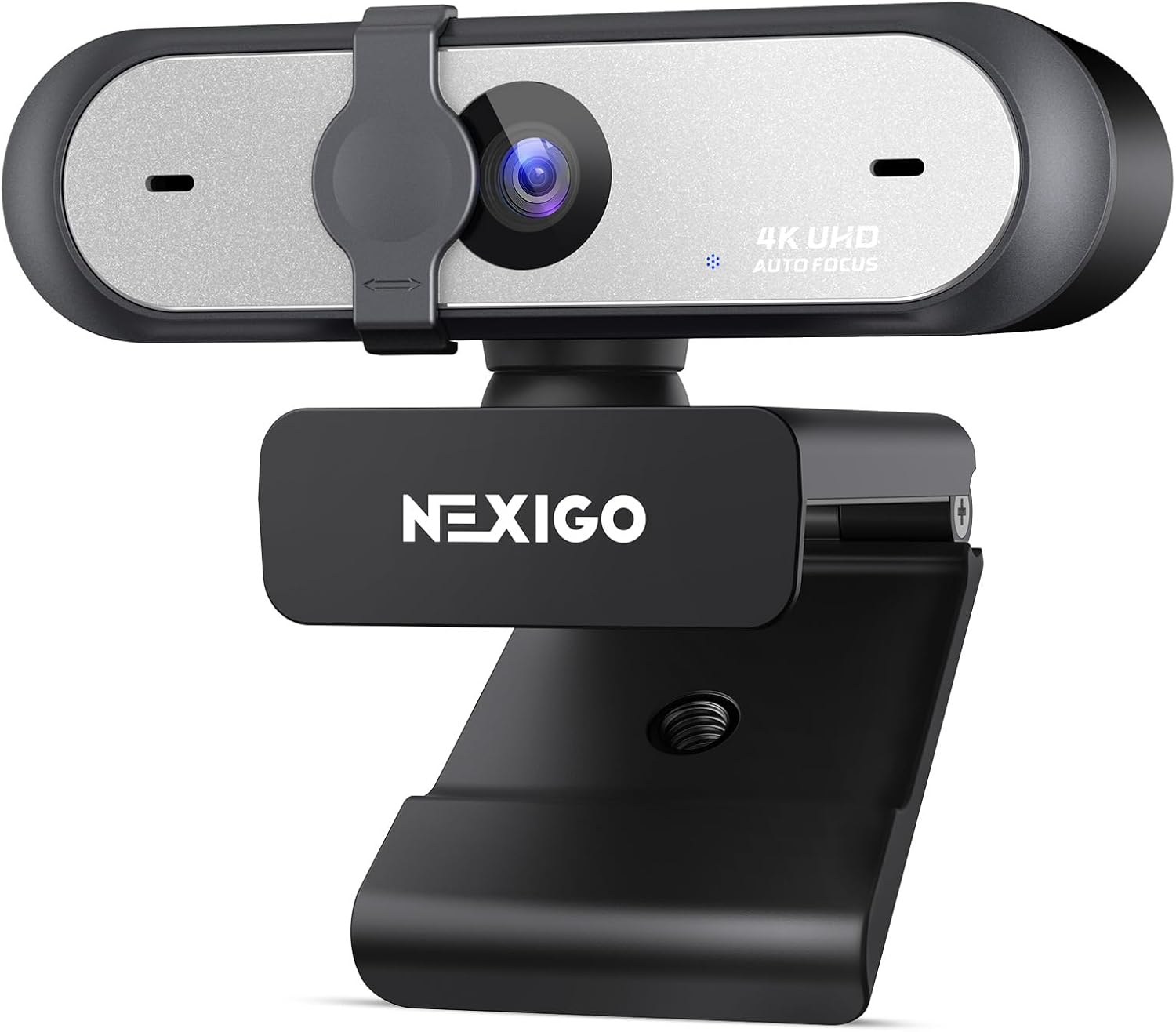
NexiGo N660P Pro 4K Webcam with Distortion-Free Lens, 1080p 60 fps Autofocus USB Streaming Camera, 3DNR, Noise-Canceling Mics & Privacy Cover, Web Cam for Gaming/Live Streaming/PC/Mac/Switch 2, Black
$50-$99This is a 4K 30fps or 1080p 60fps webcam with autofocus, dual noise-canceling mics, and a privacy cover, designed for streaming and video calls on various platforms.

NexiGo N660P Pro 4K Webcam with Distortion-Free Lens, 1080p 60 fps Autofocus USB Streaming Camera, 3DNR, Noise-Canceling Mics & Privacy Cover, Web Cam for Gaming/Live Streaming/PC/Mac/Switch 2, White
$50-$99This 4K webcam with 1080p 60 fps streaming, autofocus, and dual noise-canceling mics is for users needing high resolution and smooth video without external software.

4K Webcam with Autofocus & Tripod, Camera for PC Laptop with Dual Microphone, USB Computer Camera with Low Light Correction, Auto White Balance, Video Camera for Streaming, Meetings, Office, Zoom
$0-$49A 4K webcam with a CMOS sensor and f/2.8 aperture, designed for basic video calls and streaming on a budget.