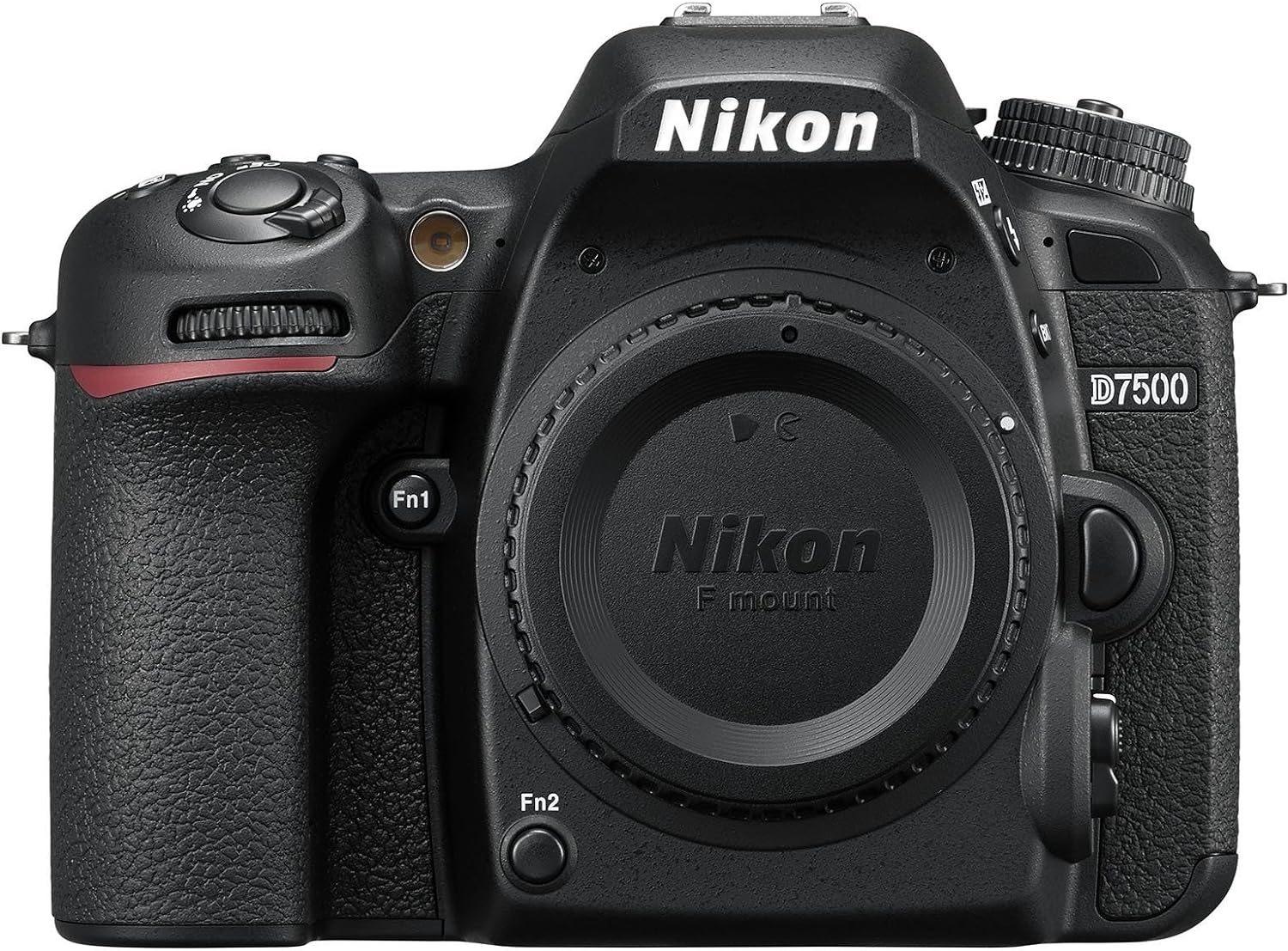
Nikon D7500 DX-Format Digital SLR Body
Want the best price and purchase timing?
Our AI advisor analyzes real-time pricing across all channels to find you the best deal.
AI Verdict
This 1.66-pound DSLR delivers 20.9-megapixel images and 4K video, but its single card slot and slow Live View AF limit its professional appeal.
This camera is a strong contender for still photographers who value its 20.9-megapixel sensor and 8 fps shooting, especially if they primarily use the optical viewfinder. However, its limitations in video (1.5x 4K crop, no 4K digital stabilization) and the single SD card slot make it less ideal for hybrid shooters or professionals.
If video is a priority, look for cameras with full-sensor 4K recording and on-sensor phase-detection autofocus for Live View.
Regret Score™
Medium RiskLower is better — measures purchase-regret risk from real buyer complaints, review credibility, and product maturity
Issues discovered after purchase
Critically weak dimension
Amazon rating vs actual quality
Chance this product isn't for you
Pros
- Captures 20.9-megapixel images with high ISO performance up to ISO 6400, producing usable files at ISO 51,200.
- Shoots continuously at 8 frames per second, supported by a 51-point AF system with 15 cross-type sensors.
- Features a 3.2-inch 922k dot tilting LCD screen with touch functionality, useful for varied shooting angles.
- Records 4K Ultra HD video, although with a 1.5x crop factor.
- Offers built-in Wi-Fi and Bluetooth for easy image transfer.
- Provides impressive battery life, with users reporting up to 3 days of continuous shooting on a single charge.
Cons
- Includes only one SD card slot, which can be a concern for critical shoots requiring immediate backups.
- Lacks an official battery grip option, making extended vertical shooting less comfortable.
- Live View autofocus is slow and contrast-detection based, making it unsuitable for tracking moving subjects.
- 4K video recording applies a 1.5x crop, narrowing the field of view significantly.
- Digital image stabilization for video is only available in Full HD mode, not 4K.
Dimension Scores
The 20.9-megapixel DX-format CMOS sensor delivers detailed images with excellent high-ISO performance up to ISO 6400.
The 51-point AF system with 15 cross-type sensors provides fast and precise autofocus for stills through the viewfinder, but Live View AF is slow.
It records 4K UHD video, but with a 1.5x crop and digital stabilization only in Full HD, which limits its utility for serious videography.
Weighing 1.66 pounds, it's a relatively lightweight and manageable DSLR body.
Best For
- Enthusiast photographers prioritizing still image quality and fast burst shooting for sports or wildlife.
- Users needing a lightweight (1.66 pounds) and durable DSLR for varied outdoor conditions.
- Photographers who primarily use the optical viewfinder and manual focusing for video.
- Those upgrading from entry-level DSLRs seeking more advanced controls and better low-light performance.
Not Recommended For
- Professional photographers requiring dual card slots for redundancy.
- Videographers who rely heavily on fast, accurate autofocus in Live View or 4K video stabilization.
- Users who need to shoot with older AI lenses, as the D7200 or D500 are better choices.
Watch Out For
- The single SD card slot means no in-camera backup for critical photos, a feature present in older D7000-series models and the D500.
- Live View autofocus is contrast-detection only and 'painfully slow' for moving subjects, forcing reliance on the viewfinder for action.
- 4K video has a significant 1.5x crop, which can make wide-angle shots challenging without specific lenses.
- There's no official battery grip, which can be an ergonomic issue for long shoots or when using heavy lenses.
- Internal audio quality is reportedly 'completely trash,' necessitating an external microphone for any serious video work.
Full Specifications
| ASIN | B06Y5ZCFHX |
| Brand | Nikon |
| Batteries | 1 Lithium Ion batteries required. (included) |
| Department | Unisex |
| Item Weight | 1.66 pounds |
| Aspect Ratio | 16:9, 3:2 |
| Manufacturer | Nikon |
| Optical Zoom | 1 x |
| Maximum Aperture | 3.5 Millimeters |
| Item model number | 1581 |
| Product Dimensions | 5.4 x 4.1 x 2.9 inches |
| Image Stabilization | Digital |
| Compatible Mountings | Nikon DX |
| Expanded ISO Minimum | 100 |
| Metering Description | Center Weighted |
| Supported File Format | JPEG, Raw |
| Photo Sensor Technology | CMOS |
| Is Discontinued By Manufacturer | No |
What Buyers Say
Many users rave about the D7500's still image quality and its ability to handle tough shooting conditions, often calling it a 'workhorse.' The biggest recurring complaints center around the single SD card slot and the slow Live View autofocus, which can be a dealbreaker for some. Despite being a DSLR in an increasingly mirrorless world, its robust build and strong still performance keep it relevant for enthusiast photographers. The 4K video crop is also a frequent point of frustration.
“Ugh, why only one card slot, Nikon?! I love the photos, especially in dim light, but I'm always sweating about losing everything if that one card dies. Still, it's a beast for my kid's soccer games.”
Common Praise
- Produces detailed 20.9-megapixel images with impressive low-light performance up to ISO 6400.
- Shoots at 8 frames per second, making it suitable for action photography.
- The 3.2-inch tilting touch screen is responsive and useful for different angles.
- Battery life is exceptional, with some users getting multiple days of shooting.
- Feels lightweight (1.66 pounds) and comfortable to handle for extended periods.
Common Complaints
- Only has one SD card slot, which is a significant drawback for professional use or peace of mind.
- Live View autofocus is slow and unreliable for moving subjects, forcing viewfinder use.
- 4K video has a 1.5x crop factor, making wide-angle video difficult.
- No official battery grip available, impacting ergonomics with larger lenses or during long shoots.
- Internal microphone quality is poor, requiring external audio solutions for video.
Ownership Tips
- The camera's high ISO performance is genuinely useful, allowing for clean shots in situations where older cameras would struggle.
- You'll quickly learn to avoid Live View for anything that moves; the optical viewfinder is where the AF system shines.
- The tilting screen is more useful than expected for low-angle shots, but don't expect to touch-focus quickly in Live View.
- Battery life is a real standout; you can often go a full day or more without needing a swap.
- If you plan on shooting video, budget for an external microphone immediately because the built-in audio is unusable.
Frequently Asked Questions
Is the D7500 good for video?
The D7500 can record 4K UHD video, but it applies a 1.5x crop factor, and digital image stabilization only works in Full HD. Live View autofocus for video is also slow.
Can I use a battery grip with the Nikon D7500?
Nikon does not offer an official battery grip for the D7500. While some third-party options exist, they are not officially supported.
What kind of sensor does the D7500 have?
It features a 20.9-megapixel DX-format CMOS sensor, which is an APS-C size sensor. This means it's a crop sensor, not full-frame.
How is the D7500's autofocus performance?
The D7500 has a 51-point AF system with 15 cross-type sensors, providing fast and precise autofocus when using the optical viewfinder, especially for sports and wildlife. However, Live View autofocus is slow.
Does the D7500 have Wi-Fi and Bluetooth?
Yes, the D7500 includes built-in Wi-Fi and Bluetooth for connectivity through the Nikon SnapBridge app.
Buying Guide
When you're looking at a DSLR like the D7500, you're buying into a system that prioritizes still photography through an optical viewfinder. Don't expect mirrorless-level Live View autofocus or advanced video features. Focus on sensor size (DX-format here means a crop sensor), megapixels for print size, and frames per second for action. The lens you pair with it will make a huge difference to your final image quality, especially with a crop sensor.
DX-format CMOS sensor (20.9-megapixel)
This is a 'crop sensor,' smaller than full-frame. It means your lenses will have a 'crop factor' (1.5x for Nikon), effectively making a 50mm lens behave like a 75mm lens. This can be a benefit for telephoto reach but makes wide-angle shots harder. More megapixels generally mean you can print larger or crop more without losing detail.
8 frames per second (fps) continuous shooting
This number tells you how many photos the camera can take in one second. 8 fps is fast enough to capture decisive moments in sports or wildlife, increasing your chances of getting a sharp shot of fast-moving subjects.
51-point AF system with 15 cross-type sensors
This describes the camera's autofocus system. More AF points, especially cross-type ones, mean the camera can focus faster and more accurately, even in challenging light or on subjects without much contrast. This is crucial for keeping moving subjects in sharp focus.
4K Ultra HD video (with 1.5x crop)
4K video offers much higher resolution than 1080p, resulting in sharper footage. However, the 1.5x crop means your lens's field of view will be significantly narrower when shooting in 4K, which can be frustrating for wide shots or in tight spaces.
Alternatives
If you need dual card slots or superior Live View autofocus for video, look for cameras with those specific features. For better low-light video or a wider field of view in 4K, consider models with full-sensor 4K recording.
You Might Also Like

NexiGo N660P Pro 4K Webcam with Distortion-Free Lens, 1080p 60 fps Autofocus USB Streaming Camera, 3DNR, Noise-Canceling Mics & Privacy Cover, Web Cam for Gaming/Live Streaming/PC/Mac/Switch 2, Pink
$50-$99This is a 4K CMOS webcam with 3DNR and dual noise-canceling mics, designed for plug-and-play use across multiple platforms.
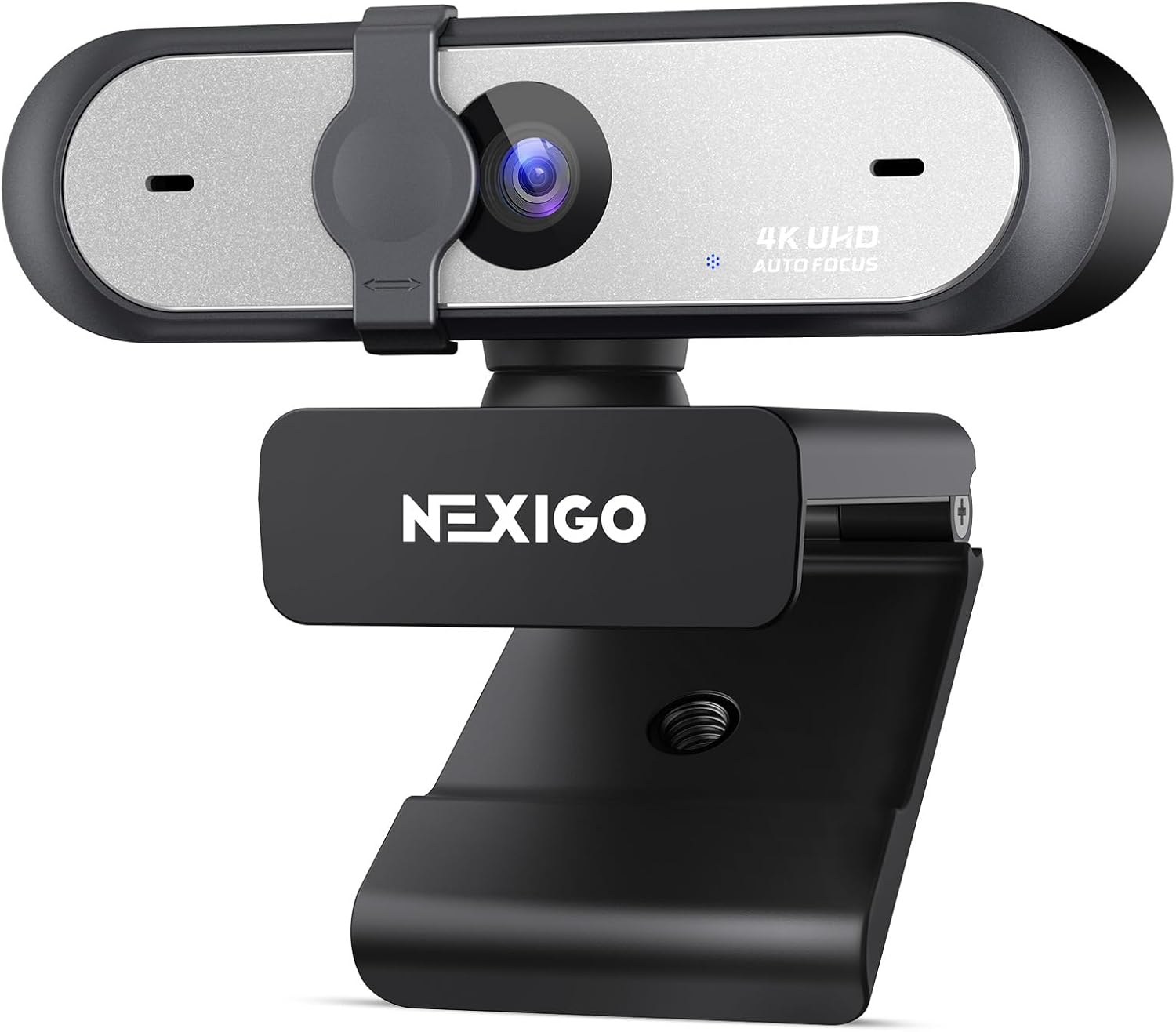
NexiGo N660P Pro 4K Webcam with Distortion-Free Lens, 1080p 60 fps Autofocus USB Streaming Camera, 3DNR, Noise-Canceling Mics & Privacy Cover, Web Cam for Gaming/Live Streaming/PC/Mac/Switch 2, Black
$50-$99This is a 4K 30fps or 1080p 60fps webcam with autofocus, dual noise-canceling mics, and a privacy cover, designed for streaming and video calls on various platforms.

NexiGo N660P Pro 4K Webcam with Distortion-Free Lens, 1080p 60 fps Autofocus USB Streaming Camera, 3DNR, Noise-Canceling Mics & Privacy Cover, Web Cam for Gaming/Live Streaming/PC/Mac/Switch 2, White
$50-$99This 4K webcam with 1080p 60 fps streaming, autofocus, and dual noise-canceling mics is for users needing high resolution and smooth video without external software.

4K Webcam with Autofocus & Tripod, Camera for PC Laptop with Dual Microphone, USB Computer Camera with Low Light Correction, Auto White Balance, Video Camera for Streaming, Meetings, Office, Zoom
$0-$49A 4K webcam with a CMOS sensor and f/2.8 aperture, designed for basic video calls and streaming on a budget.