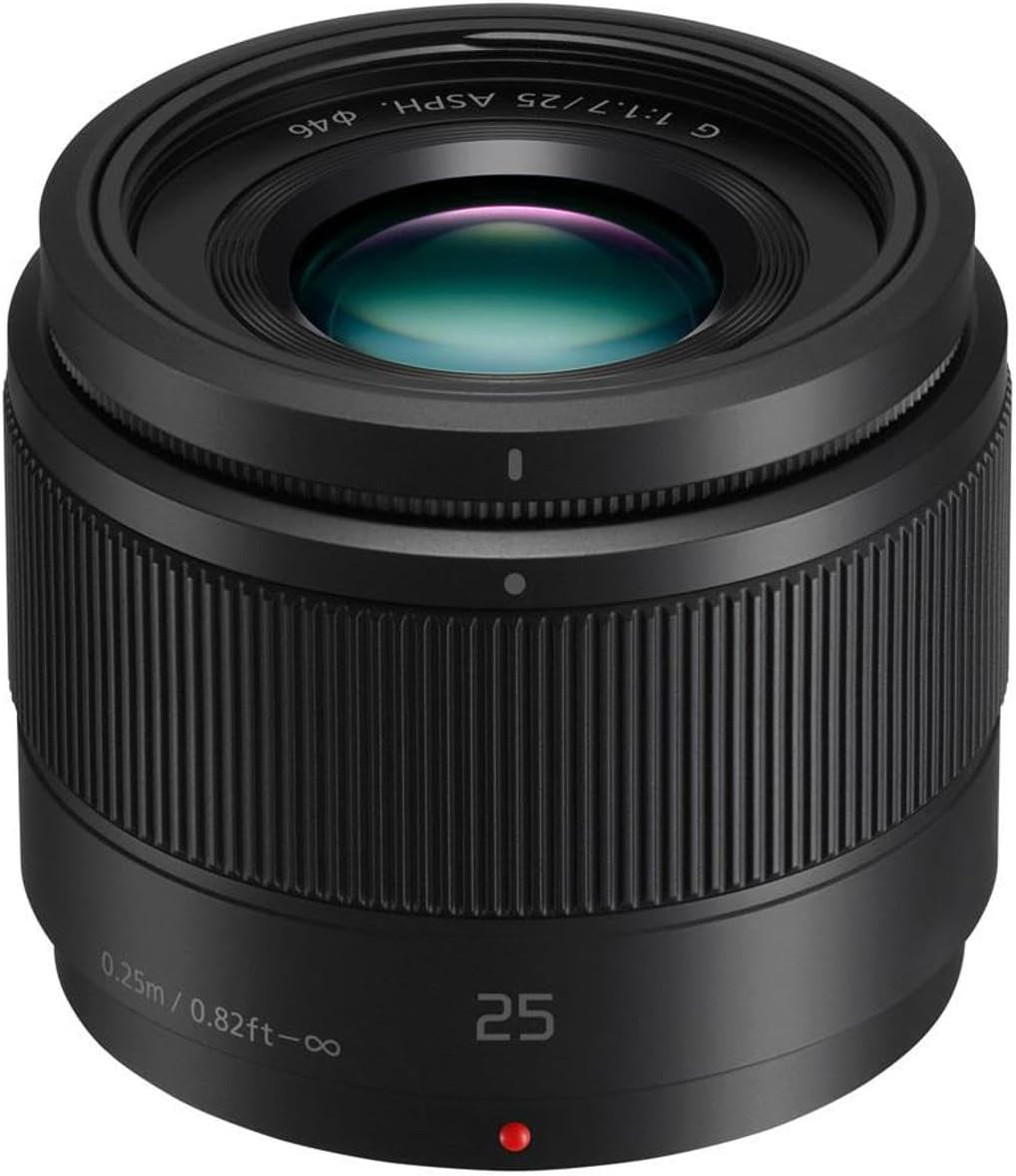
Panasonic LUMIX G Lens, 25mm, F1.7 ASPH, Mirrorless Micro Four Thirds, H-H025K (USA Black)
Want the best price and purchase timing?
Our AI advisor analyzes real-time pricing across all channels to find you the best deal.
AI Verdict
This 25mm F1.7 Micro Four Thirds lens is a lightweight 125g prime for M43 users seeking a fast, compact 50mm equivalent.
This lens is a strong fit for Micro Four Thirds users looking for a fast, lightweight prime. Its 25mm focal length (50mm equivalent) and F1.7 aperture provide excellent low-light capability and background separation, all in a compact 125g package.
If you need built-in image stabilization or even better low-light performance, look for lenses with OIS or a wider aperture like F1.4.
Regret Score™
Very Low RiskLower is better — measures purchase-regret risk from real buyer complaints, review credibility, and product maturity
Issues discovered after purchase
Critically weak dimension
Amazon rating vs actual quality
Chance this product isn't for you
Pros
- The F1.7 aperture creates a pleasing background bokeh effect.
- It weighs only 125g, making it very lightweight and compact.
- Autofocus is fast and quiet, especially on Panasonic bodies, enabling smooth video recording.
- Many users report it delivers sharp images even at F1.7.
- It includes a plastic lens hood in the box.
- It offers significant value for its price point in the M43 system.
Cons
- The lens lacks optical image stabilization (OIS), requiring a camera body with IBIS for stabilized handheld shots.
- A focus shift issue can occur when stopping down the aperture, which some users find visible upon close inspection.
- Autofocus can occasionally miss focus on distant subjects, typically to the front, especially in dim lighting.
- Some users observe corner softness at wider apertures like F1.7 and F2.
- It is physically larger than some comparable Olympus 25mm F1.8 lenses.
Dimension Scores
The F1.7 aperture delivers pleasing bokeh and good sharpness wide open, though some users report corner softness at wider apertures and a focus shift issue when stopped down.
The lens features a fast and quiet stepping motor, providing quick focus acquisition, especially on Panasonic bodies, though it can occasionally miss distant subjects.
Its quiet and smooth autofocus is beneficial for video, but the absence of optical image stabilization means stability relies solely on the camera body's IBIS.
Weighing only 125g and having a compact length of 2.05 inches, it's highly portable for a fast prime lens.
Best For
- Micro Four Thirds photographers desiring a 50mm equivalent prime lens.
- Capturing images in low-light conditions due to its F1.7 aperture.
- Street photography, offering a natural viewing angle.
- Achieving shallow depth of field and background blur in portraits.
Not Recommended For
- Users who require in-lens image stabilization for handheld shooting on bodies without IBIS.
- Critical landscape photography at smaller apertures where focus shift could be problematic.
- Those prioritizing the absolute smallest 25mm prime lens available for M43.
Watch Out For
- Lack of optical image stabilization means blurry photos if your camera body doesn't have IBIS and you're shooting handheld at slower shutter speeds.
- The lens exhibits focus shift when stopping down the aperture; some users report it's noticeable when zooming in or cropping images.
- Autofocus can miss for distant subjects, consistently focusing slightly in front, which is more prevalent in dim light.
- Some copies show corner softness at F1.7 and F2, which might be an issue for specific photographic styles.
Full Specifications
| ASIN | B014RD6RC0 |
| Brand | Panasonic |
| Batteries | 1 Lithium Ion batteries required. |
| Lens Type | Standard |
| Item Weight | 7.8 ounces |
| Manufacturer | Panasonic |
| Item model number | H-H025K |
| Product Dimensions | 3.23 x 3.23 x 4.41 inches |
| Compatible Mountings | Four Thirds |
| Camera Lens Description | 25 millimetres |
| Focal Length Description | F 1.7 |
| Is Discontinued By Manufacturer | No |
What Buyers Say
Many users consider this 25mm F1.7 lens to be the 'nifty fifty' of the Micro Four Thirds system, offering a compelling blend of performance and value. Its F1.7 aperture is frequently praised for creating attractive background blur and enabling low-light shooting. While its autofocus is generally quick and quiet, a recurring point of discussion is the lack of optical image stabilization, which means handheld shooting stability depends entirely on the camera body's IBIS. Some photographers also note a focus shift when stopping down the aperture, which can affect sharpness in certain scenarios.
“Okay, so I got this lens because everyone said it was the budget 'nifty fifty' and honestly, for the price, the bokeh is really nice and it's so light, but seriously, why no OIS? My night shots are still blurry if I don't crank the ISO or use a tripod, and that focus shift thing is annoying when I try to stop down for landscapes. Still, it's usually on my camera.”
Common Praise
- The F1.7 aperture consistently produces beautiful background blur.
- It's incredibly lightweight at 125g, making it easy to carry all day.
- Autofocus is fast and operates quietly, which is beneficial for both photos and video.
- Images are reported to be sharp even when shooting wide open at F1.7.
- Many users highlight its exceptional value for the features it offers at its price point.
- The lens comes with a plastic lens hood, which is a practical addition.
Common Complaints
- The absence of optical image stabilization means you need a camera with IBIS for stable handheld shots.
- There's a noticeable focus shift issue when stopping down the aperture, impacting sharpness at smaller apertures for some users.
- Autofocus can sometimes miss on distant subjects, consistently focusing slightly in front, especially in dim conditions.
- Some users report that the corners of images can appear soft at F1.7 and F2.
- It's physically larger than some competing 25mm F1.8 lenses from Olympus.
Ownership Tips
- You'll quickly learn the importance of your camera's IBIS or a fast shutter speed for handheld shots, especially in lower light, due to the lack of OIS.
- The focus shift issue, while not always critical, becomes apparent if you pixel-peep or crop heavily after stopping down the aperture.
- The plastic construction, while contributing to its light weight, doesn't feel as premium as some metal-bodied lenses.
- Using this prime lens means you'll be 'zooming with your feet' a lot more, which can actually improve your compositional skills.
Frequently Asked Questions
Does this lens have image stabilization?
No, the Panasonic LUMIX G 25mm F1.7 ASPH does not have optical image stabilization (OIS). It relies on your camera body's in-body image stabilization (IBIS) if available.
Is this lens suitable for video recording?
Yes, its quiet and smooth stepping motor focusing makes it suitable for HD video recording. However, without OIS, handheld video may require a camera with IBIS for stability.
What is the 35mm camera equivalent focal length of this lens?
On a Micro Four Thirds camera, the 25mm focal length provides a natural viewing angle equivalent to a 50mm lens on a 35mm full-frame camera.
Is the lens sharp when shot wide open at F1.7?
Many users report that the lens is sharp even when used wide open at F1.7, allowing for good detail and background blur.
Does the lens come with a hood?
Yes, the Panasonic LUMIX G 25mm F1.7 ASPH includes a plastic lens hood in the box.
Buying Guide
When looking at a lens like this, you're essentially choosing a specific perspective and light-gathering ability. The '25mm' tells you how wide your view will be – on a Micro Four Thirds camera, it's like a classic 50mm view on older film cameras, which is very natural. The 'F1.7' is super important; it means the lens can open up really wide, letting in a lot of light for dim scenes and giving you that blurry background effect that makes your subject pop.
25mm focal length (50mm equivalent)
This gives you a 'standard' or 'natural' field of view, similar to how the human eye sees. It's not super wide like a landscape lens, nor super zoomed in like a telephoto, making it versatile for many everyday situations.
F1.7 aperture
This large aperture lets in a lot of light, so you can shoot in darker environments without cranking up your ISO too much. It also creates a shallow depth of field, blurring out the background to isolate your subject, which is often called 'bokeh'.
Micro Four Thirds
This specifies the camera system the lens is designed for. It means it will only work natively with Micro Four Thirds cameras (like Panasonic Lumix G series or Olympus OM-D/PEN series), and it dictates the 2x crop factor that makes 25mm equivalent to 50mm on full-frame.
Alternatives
If this lens doesn't quite fit, consider a 25mm F1.4 lens for even better low-light performance and bokeh, or a 25mm F1.8 lens if you prioritize a smaller physical size and potentially better corner sharpness.
You Might Also Like

NexiGo N660P Pro 4K Webcam with Distortion-Free Lens, 1080p 60 fps Autofocus USB Streaming Camera, 3DNR, Noise-Canceling Mics & Privacy Cover, Web Cam for Gaming/Live Streaming/PC/Mac/Switch 2, Pink
$50-$99This is a 4K CMOS webcam with 3DNR and dual noise-canceling mics, designed for plug-and-play use across multiple platforms.
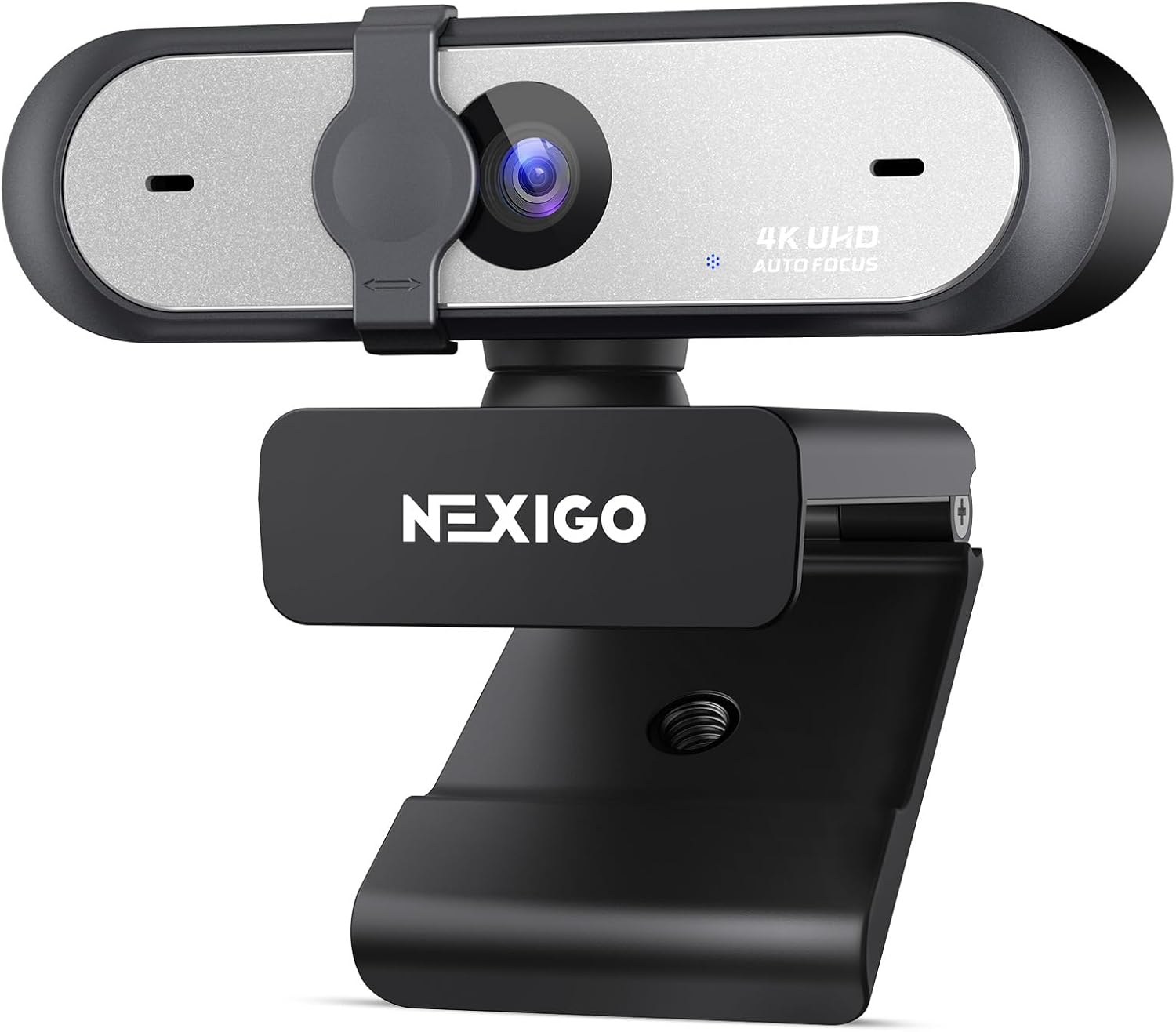
NexiGo N660P Pro 4K Webcam with Distortion-Free Lens, 1080p 60 fps Autofocus USB Streaming Camera, 3DNR, Noise-Canceling Mics & Privacy Cover, Web Cam for Gaming/Live Streaming/PC/Mac/Switch 2, Black
$50-$99This is a 4K 30fps or 1080p 60fps webcam with autofocus, dual noise-canceling mics, and a privacy cover, designed for streaming and video calls on various platforms.

NexiGo N660P Pro 4K Webcam with Distortion-Free Lens, 1080p 60 fps Autofocus USB Streaming Camera, 3DNR, Noise-Canceling Mics & Privacy Cover, Web Cam for Gaming/Live Streaming/PC/Mac/Switch 2, White
$50-$99This 4K webcam with 1080p 60 fps streaming, autofocus, and dual noise-canceling mics is for users needing high resolution and smooth video without external software.

4K Webcam with Autofocus & Tripod, Camera for PC Laptop with Dual Microphone, USB Computer Camera with Low Light Correction, Auto White Balance, Video Camera for Streaming, Meetings, Office, Zoom
$0-$49A 4K webcam with a CMOS sensor and f/2.8 aperture, designed for basic video calls and streaming on a budget.