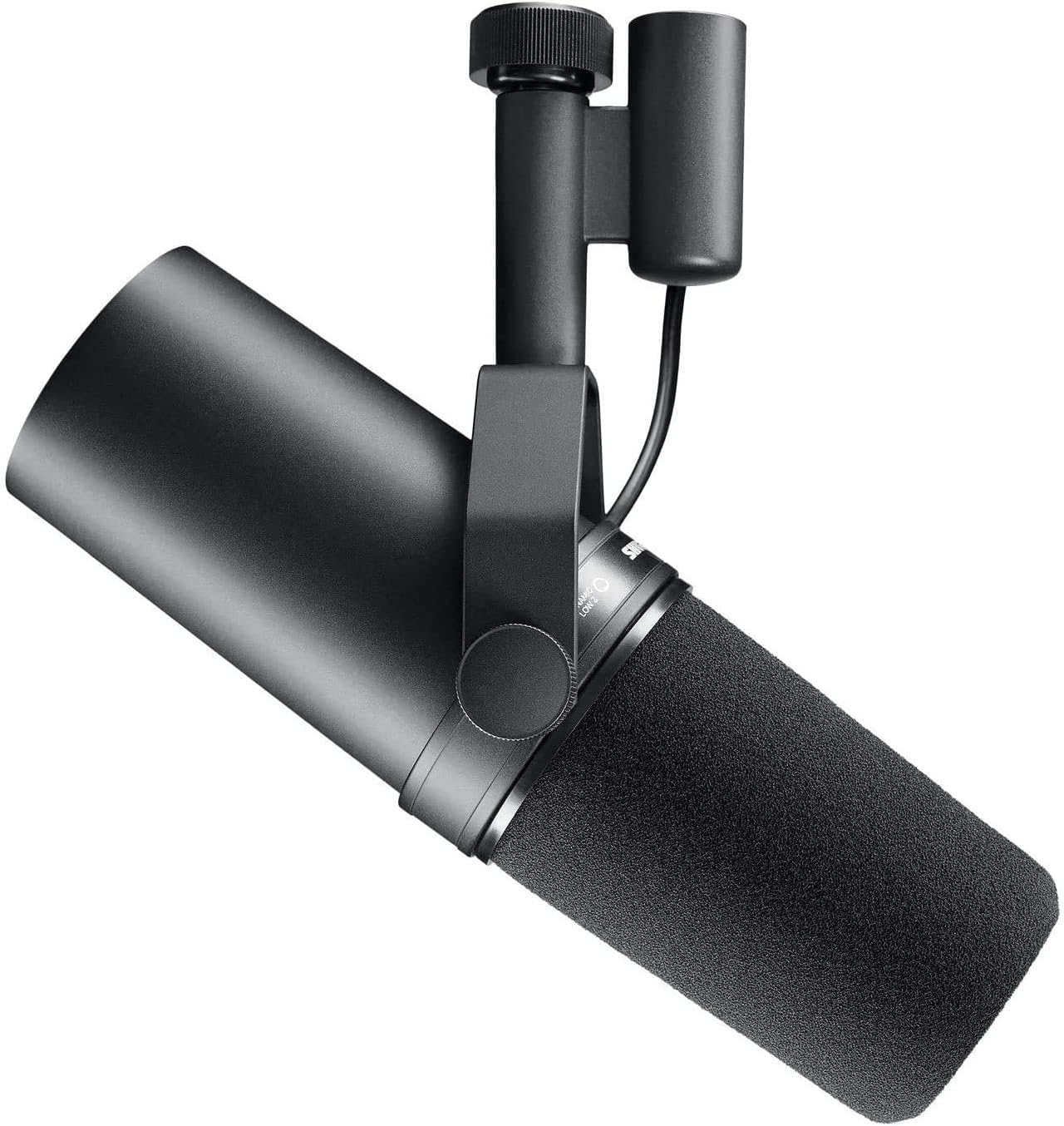
Shure SM7B Vocal Dynamic Microphone – XLR Studio Mic for Podcasting, Recording, Broadcasting, Streaming & Gaming – Smooth, Warm Sound, Rugged Build, Detachable Windscreen, Wide Frequency Range, Black
Want the best price and purchase timing?
Our AI advisor analyzes real-time pricing across all channels to find you the best deal.
AI Verdict
This is the industry-standard mic for serious podcasters and streamers who have the budget for a powerful audio interface to make it sound as good as it can.
This is a strong fit if you're committed to building a professional audio setup and have the budget for it. Its legendary sound quality and noise rejection are top-tier, but only if you pair it with a high-gain preamp, which is a significant hidden cost and complexity for many users.
If you want the SM7B sound without the hassle, look for the Shure SM7dB, which has a high-quality preamp built directly into the microphone.
Regret Score™
Medium RiskLower is better — measures purchase-regret risk from real buyer complaints, review credibility, and product maturity
Issues discovered after purchase
Critically weak dimension
Amazon rating vs actual quality
Chance this product isn't for you
Pros
- Excellent rejection of off-axis audio, isolating your voice from room noise and keyboard clicks.
- Rugged, all-metal construction feels like it will last for decades.
- The built-in pop filter and shock isolation effectively reduce plosives and handling noise.
- Delivers that classic, warm 'broadcast' sound with a smooth and natural character.
- Takes EQ processing extremely well, allowing for a lot of flexibility in post-production.
Cons
- Requires at least 60dB of clean gain, which most entry-level audio interfaces can't provide without introducing hiss.
- It's heavy at 2.7 pounds, so cheap or flimsy boom arms will sag under its weight.
- The raw, flat sound out of the box can sound 'muffled' or 'dull' without EQ adjustments.
- The total cost is high when you factor in the necessary powerful preamp or an in-line booster like a Cloudlifter.
Dimension Scores
When powered correctly, it delivers an iconic, warm, and smooth broadcast sound that is an industry standard for a reason.
The mic has notoriously low output volume, requiring at least 60dB of external gain, which is a major hurdle for many users.
The professional XLR connection is robust and standard for studio gear, but it's a barrier for beginners who expect a simple USB plug.
It's built like an absolute tank, but its 2.7-pound weight and large size make it difficult to transport and require a heavy-duty stand.
Best For
- Dedicated podcasting or streaming setups in rooms with minimal acoustic treatment.
- Recording vocals for music, especially rock and hip-hop, where a warm, controlled sound is desired.
- Professional voice-over work where consistency and noise rejection are critical.
- Any creator who wants the iconic 'look' of a professional broadcast studio.
Not Recommended For
- Beginners looking for a simple plug-and-play USB microphone.
- Users on a tight budget who don't want to buy an audio interface and a mic booster.
- Recording on the go or in situations where a lightweight, portable setup is needed.
Watch Out For
- You will almost certainly need to buy a Cloudlifter or FetHead for about $150 to get a clean, strong signal, as most affordable interfaces produce audible hiss when their gain is maxed out.
- It doesn't come with an XLR cable or a stand, which are required to use it.
- The heavy weight and bulky size can obscure your face on camera and require a very sturdy, often expensive, boom arm to hold it in position without drooping.
- The raw audio can sound underwhelming and 'muddy' until you learn to apply post-production EQ to shape the sound.
- Over time, the three small screws holding the backplate can come loose, causing the XLR connector to wobble.
Full Specifications
| UPC | 042406088879 716053675859 |
| ASIN | B0002E4Z8M |
| Size | 13.5 x 7 x 4.5 inches |
| Brand | Shure |
| Color | Charcoal Gray |
| Voltage | 1.12 Millivolts |
| Material | Metal |
| Batteries | 1 C batteries required. |
| Impedance | 150 Ohms |
| Color Name | Charcoal Gray |
| Model Name | SM7B |
| Item Weight | 2.7 pounds |
| Manufacturer | Shure |
| Power Source | The SM7B does NOT require phantom power and is not affected if phantom power is present on its mixer input. Note that some third-party external pre-amps commonly used with the SM7B DO require phantom power to operate, however. At least 60dB of gain is recommended to get that iconic warm and balanced tone most commonly associated with the SM7B. |
| Material Type | Metal |
| Polar Pattern | Unidirectional |
| Connector Type | XLR |
| Special Feature | Shielding |
| Hardware Platform | Personal Computer (MVX2U sold separately) |
| Item model number | SM7B |
| Compatible Devices | Personal Computer |
| Frequency Response | 20000 Hz |
| Number of Channels | 1 |
| Product Dimensions | 13.5 x 7 x 4.5 inches |
| Included Components | Close-Talk Windscreen, Foam Windscreen, Locking Yoke Mount |
| Number of Batteries | 1 C batteries required. |
| Signal-to-Noise Ratio | 60 dB |
| Microphone Form Factor | Dynamic |
| Connectivity Technology | XLR |
| Item dimensions L x W x H | 13.5 x 7 x 4.5 inches |
| Recommended Uses For Product | Music Production, Vocal Recording and Podcasting |
| Is Discontinued By Manufacturer | No |
| Global Trade Identification Number | 00042406088879 |
What Buyers Say
The most surprising thing you'll discover after buying an SM7B is that the price on the box is just a down payment. It's famously 'gain hungry,' meaning your current audio interface probably can't make it loud enough without adding a ton of background hiss, forcing you to buy a $150 Cloudlifter. Once you solve the power issue, the mic is a dream for rejecting background noise—it barely picks up keyboard clicks or room echo. The sound right out of the box is very flat and can even seem 'dull' until you start using EQ to shape it into that rich, pro sound you hear on podcasts. It's also incredibly heavy, so be prepared for your cheap mic arm to sag immediately.
“i finally splurged on this thing and my first recording was SO quiet and muddy i thought it was broken... turns out you need to spend ANOTHER $150 on a cloudlifter to make it actually work right, wish someone told me that first.”
Common Praise
- The off-axis rejection is incredible; you can have a mechanical keyboard and it barely gets picked up.
- The build quality is legendary; it feels like a piece of professional equipment that will outlive you.
- Once you get it set up right, the sound is buttery smooth and makes your voice sound rich and professional.
- You don't need a separate pop filter because the included windscreen does an amazing job of taming plosives.
- It's extremely forgiving if you move around a bit while talking, maintaining a consistent tone.
Common Complaints
- The output level is so low that maxing out the gain on a Scarlett 2i2 results in insufferable background hiss.
- It's an incomplete product; for the price, it's shocking it doesn't even include a basic XLR cable.
- The raw audio sounds flat and muddy, requiring post-processing to sound like you expect it to.
- It's so heavy and bulky that it can completely block your face on stream and makes cheap boom arms useless.
- The 'hidden cost' of a Cloudlifter and a proper interface makes the real price closer to $550-$600.
Ownership Tips
- After a few months, you stop thinking about the gear and just appreciate how consistent the audio is, no matter the background noise.
- You'll eventually find the perfect EQ setting for your voice and save it as a preset you use on every recording.
- The recessed switches on the back for the high-pass filter are impossible to flip without a pen or screwdriver, so you just set them once and forget them.
- The large foam windscreen gets dusty and needs to be removed and cleaned more often than you'd think.
- You'll find yourself recommending it to friends, but always starting with a 10-minute explanation about gain and preamps.
Frequently Asked Questions
Do I really need a Cloudlifter for the SM7B?
Most likely, yes. The SM7B has a very low output, and most audio interfaces under $500 will introduce noticeable noise when you turn the gain up high enough. A Cloudlifter or FetHead provides clean gain to solve this common issue.
Does the Shure SM7B need phantom power?
No, the SM7B itself does not require phantom power. However, an in-line preamp like a Cloudlifter, which is often necessary, DOES require phantom power from your audio interface to operate.
Why does my SM7B sound muffled or quiet?
This is the most common complaint and it's due to needing a lot of gain. Your audio interface's preamp is likely not powerful enough on its own. The 'muffled' sound is also characteristic of its flat frequency response, which is designed to be shaped with EQ in post-production.
Is the SM7B good for rooms that aren't soundproofed?
Yes, this is one of its biggest strengths. Its cardioid pickup pattern is very effective at rejecting background noise, making it a great choice for untreated home studios or rooms with some ambient noise.
Is the SM7B worth it for just streaming or gaming?
It can be overkill for many. While it provides pro-level quality, you can achieve a stream-ready sound with more affordable and simpler mics like the Shure MV7 or Rode PodMic that don't require expensive extra gear.
Do I need a separate pop filter?
For most voice applications, the included foam windscreen is excellent and you won't need an additional pop filter. It's very effective at controlling plosives ('p' and 'b' sounds) even when speaking close to the mic.
Buying Guide
Think of the SM7B not as a microphone, but as a microphone *system*. You're not just buying the mic, you're buying into a chain of gear. The main thing you need to understand is 'gain'—this mic needs a LOT of it. If your audio interface can't provide enough clean power, your recordings will be quiet and hissy. You have to budget for the mic AND a powerful interface or an in-line booster from day one.
Dynamic Microphone
Unlike sensitive condenser mics that pick up every little noise, a dynamic mic is less sensitive. This is great for typical rooms because it focuses on your voice and ignores a lot of the echo and background noise.
XLR Connection
This isn't a USB mic you plug into your computer. It uses a professional 3-pin XLR cable that connects to an audio interface or mixer. This gives you more control but adds another piece of gear (and cost) to your setup.
Requires ~60dB of Gain
This is the most critical spec. Think of 'gain' as the mic's volume knob. This mic's knob only goes to 2, so you need an external amplifier (a good preamp) to turn it up to 10 without adding static. Most basic interfaces can't do this cleanly.
Cardioid Polar Pattern
Imagine the mic can only 'hear' in a heart-shape directly in front of it. That's cardioid. It's designed to capture what's right in front (your mouth) and reject sounds from the sides and back (your keyboard, your fan).
Alternatives
If this setup seems too complex or expensive, look for a high-quality USB microphone with a built-in headphone jack for monitoring, or a hybrid USB/XLR mic like the Shure MV7 for more flexibility.
You Might Also Like

Computer Speakers for Desktop PC Monitor, USB Plug-in, Wired, Computer Soundbar for PC, Laptop Speakers with Adaptive-Channel-Switching, Loud Sound, Deep Bass, USB C Adapter, Easy to Clip on Monitor
Price range unavailableThis $30 clip-on USB soundbar is a massive upgrade over tinny laptop speakers, perfect for cramped home offices that need clear audio without the cable clutter of a 2.1 system.

Bluetooth Pillow Speaker for Sleeping, Mini Portable Under Pillow Speaker with White Noise Timer Wireless Sleep Aid with Stereo Bass Private Sleep Headphones for Adult Kids
$0-$49A 3-Watt stereo Bluetooth 5.4 pillow speaker with 20-hour battery life and white noise, designed for private listening without disturbing others.

Amazon Echo Pop (newest model), Our smallest speaker with Alexa+ Early Access, Fits in any room, Charcoal
This is Amazon's cheapest, smallest Alexa speaker, built for adding voice control to tight spaces like a bathroom or dorm room, not for filling a room with music.

Amazon Echo Pop (newest model), Our smallest speaker with Alexa+ Early Access, Fits in any room, Midnight Teal
This is a cheap, no-frills Alexa speaker for small spaces like bathrooms and hallways, not for anyone who actually cares about music quality.